

Why Multi-Answer?
RFP Response
Complete 100+ vendor questionnaires in hours instead of weeks
Security Questionnaires
Answer SOC 2, ISO 27001, and vendor security assessments at scale
Compliance Audits
Handle GDPR, HIPAA, PCI-DSS questionnaires with consistent answers
Due Diligence
Respond to investor or M&A questionnaires quickly
Real-World Use Cases
RFP & Vendor Questionnaires
RFP & Vendor Questionnaires
The problem: Your sales team receives a 150-question RFP with a 1-week deadline. Manually researching and writing each answer takes days.With Multi-Answer:
- Export the RFP questions to Excel
- Upload to Multi-Answer Jobs
- Get draft answers in minutes, backed by your 100+ real customer RFP documents, playbooks, and product docs
- Review, refine, and submit
Security & Compliance Questionnaires
Security & Compliance Questionnaires
The problem: Enterprise customers send security questionnaires (SOC 2, VSA, CAIQ) with 200+ questions. Your security team is overwhelmed.With Multi-Answer:
- Upload your security policies, SOC 2 report, and compliance docs as data sources
- Import the customer’s questionnaire
- Generate answers that reference your actual policies
- Security team reviews instead of writes from scratch
Due Diligence & Investor Questions
Due Diligence & Investor Questions
The problem: During fundraising or M&A, you receive extensive due diligence questionnaires covering legal, financial, and technical details.With Multi-Answer:
- Upload relevant internal documentation
- Process the due diligence questionnaire
- Get consistent, accurate answers across all categories
- Legal/finance teams review and approve
Knowledge Base Quality Audit
Knowledge Base Quality Audit
The problem: You want to test if your knowledge base can answer the most common customer questions accurately.With Multi-Answer:
- Export your top 100 support questions
- Run them through Multi-Answer
- Review trust scores and identify gaps
- Add missing content to your knowledge base
Getting Started
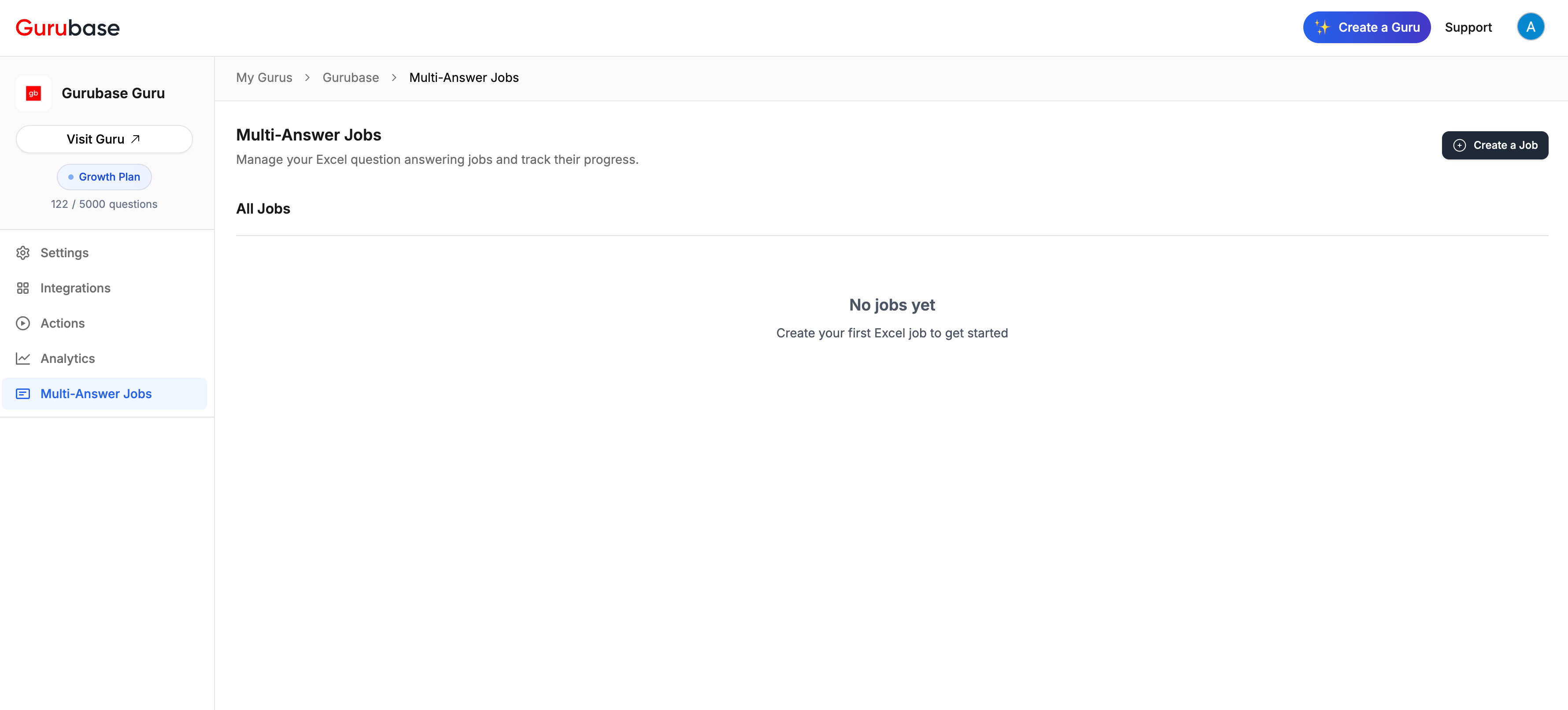
Creating a Multi-Answer Job
Creating a job has two parts: first choose which sheets to answer, then map the columns for each of those sheets. Job-wide settings — the general instruction, Answer Tools, and source/label filters — are set once and apply to every selected sheet.Step 1: Upload Excel File
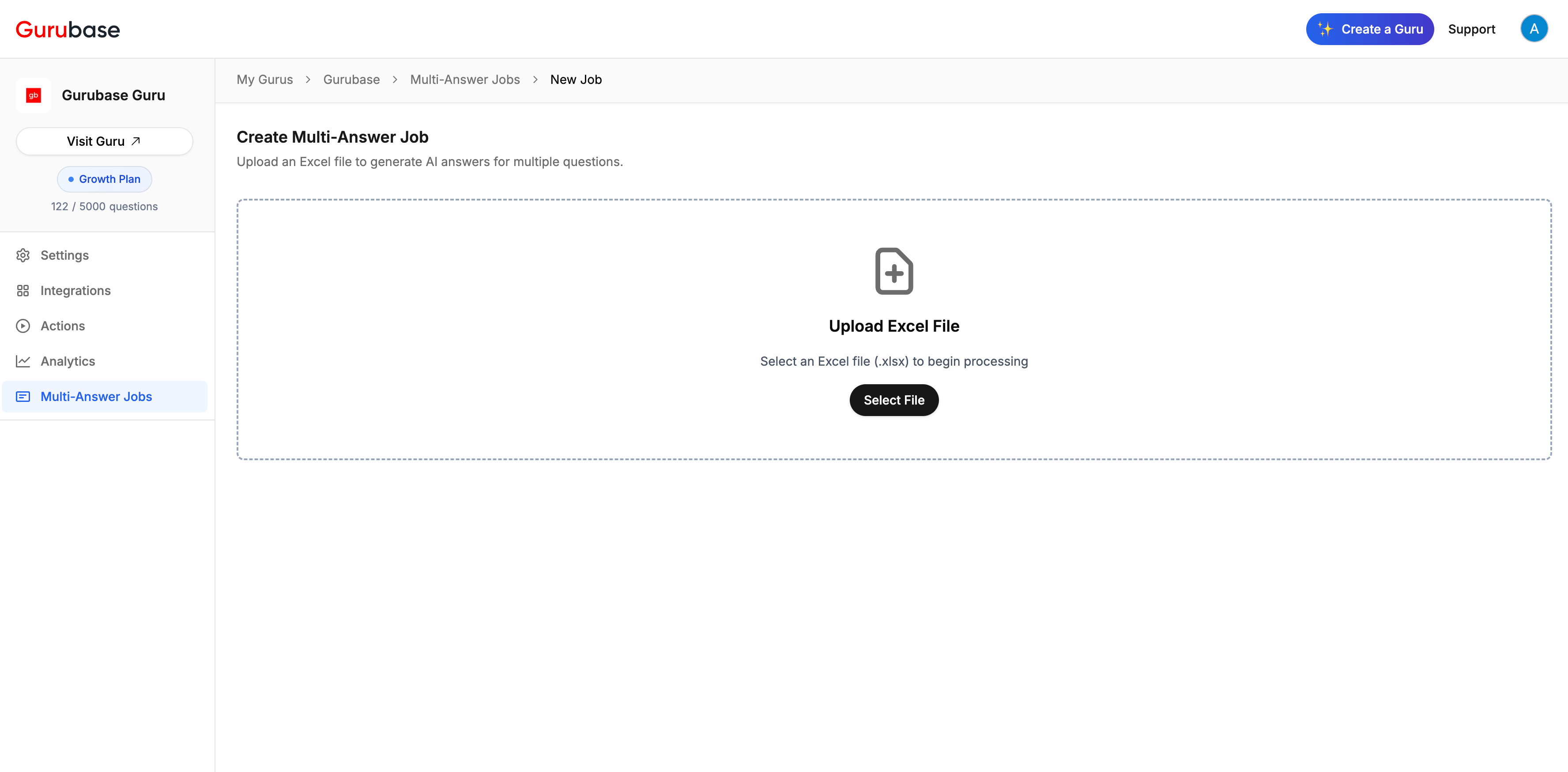
.xlsx format). Click “Select File” to choose the workbook containing the questions you want to process.
Step 2: Choose the sheets to answer
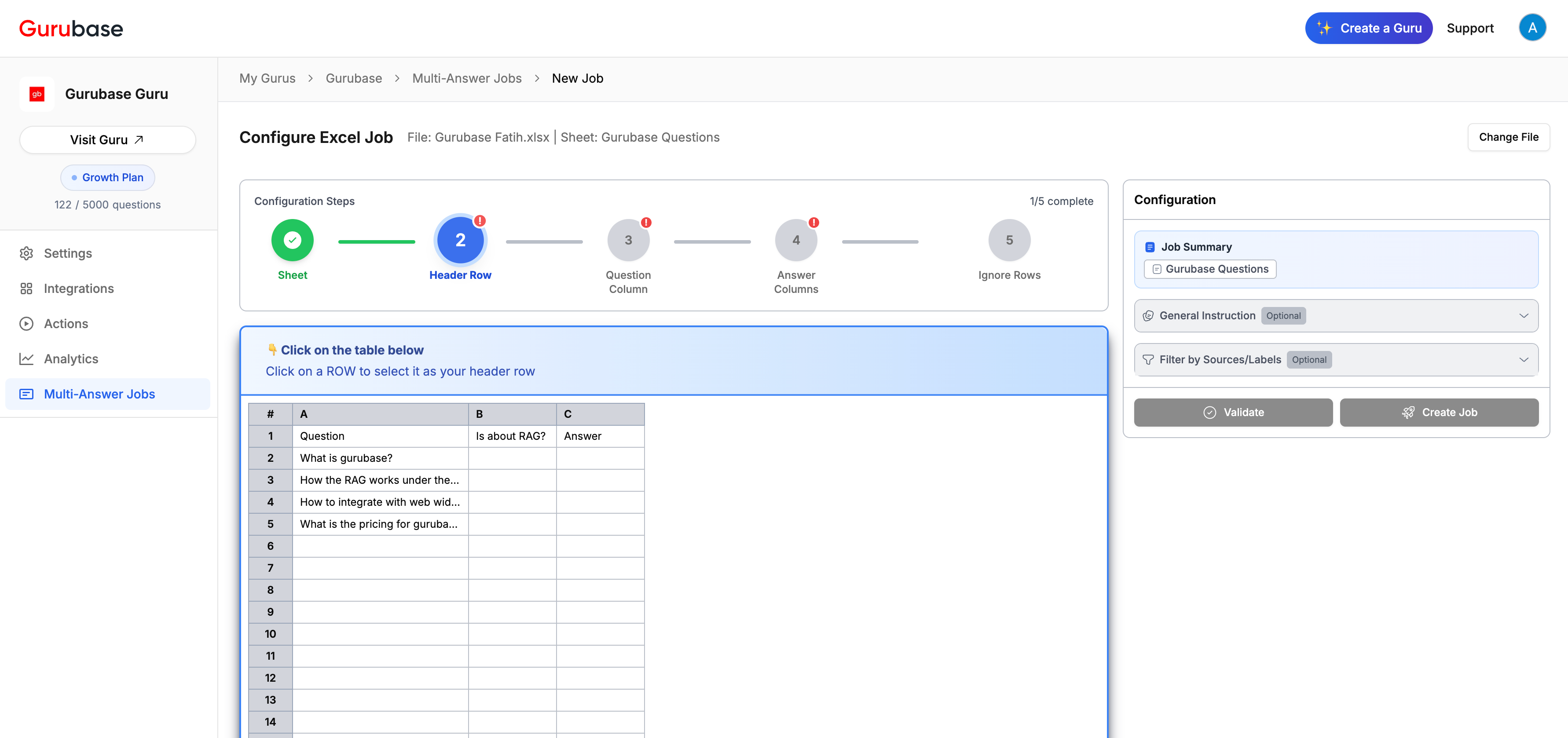
- Tick the sheets you want to process, or use Select all visible to select them at once.
- Hidden sheets appear with a
hiddenbadge and are left unchecked by default — they are usually scratch or archive data. Check them explicitly if you do want them answered. - The preview opens on the first visible sheet; click any sheet to preview it.
If the workbook has only one sheet, this step is skipped and you go straight to mapping.
Step 3: Map each selected sheet
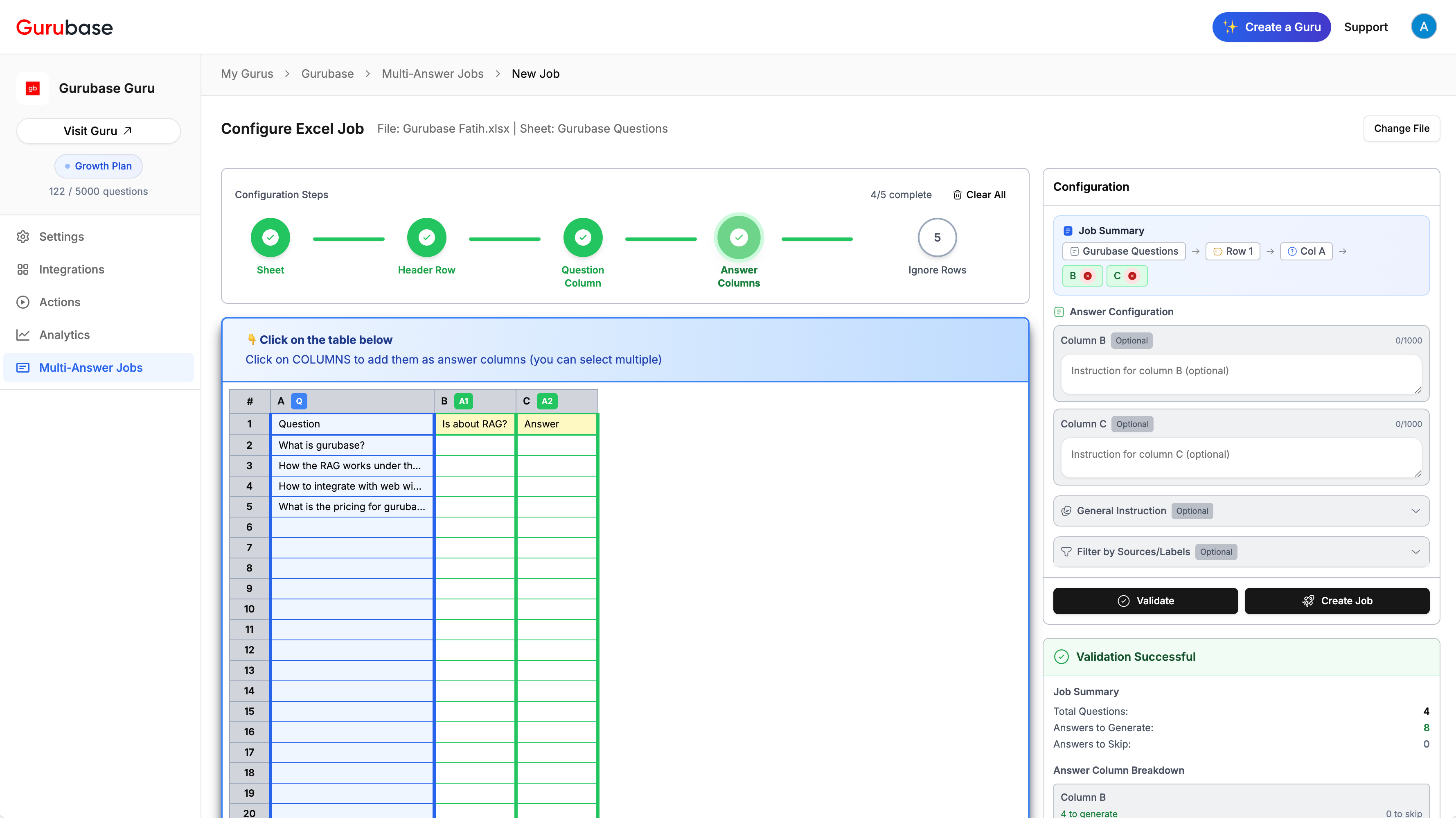
Each sheet is mapped independently, so sheets with completely different layouts can run in the same job. A rail lists your selected sheets with a per-sheet status: ● currently mapping, ✓ fully mapped, and ! still needs mapping. Work through each sheet and set the four mappings below; the job can’t start until every selected sheet shows ✓. Header row, question column, and answer columns are set per sheet, so sheets with completely different layouts can run in the same job. A per-sheet status indicator (● / ✓ / !) shows which sheets are fully mapped and which still need setup. The Run button stays disabled until every selected sheet is fully mapped, so a sheet is never silently skipped.Header Row
Click the row that contains this sheet’s column headers. Typically row 1, but you can select any row with column labels.Question Column
Click the column header (e.g., column A) to designate it as the question column. All rows below the header row are processed as questions.Answer Columns
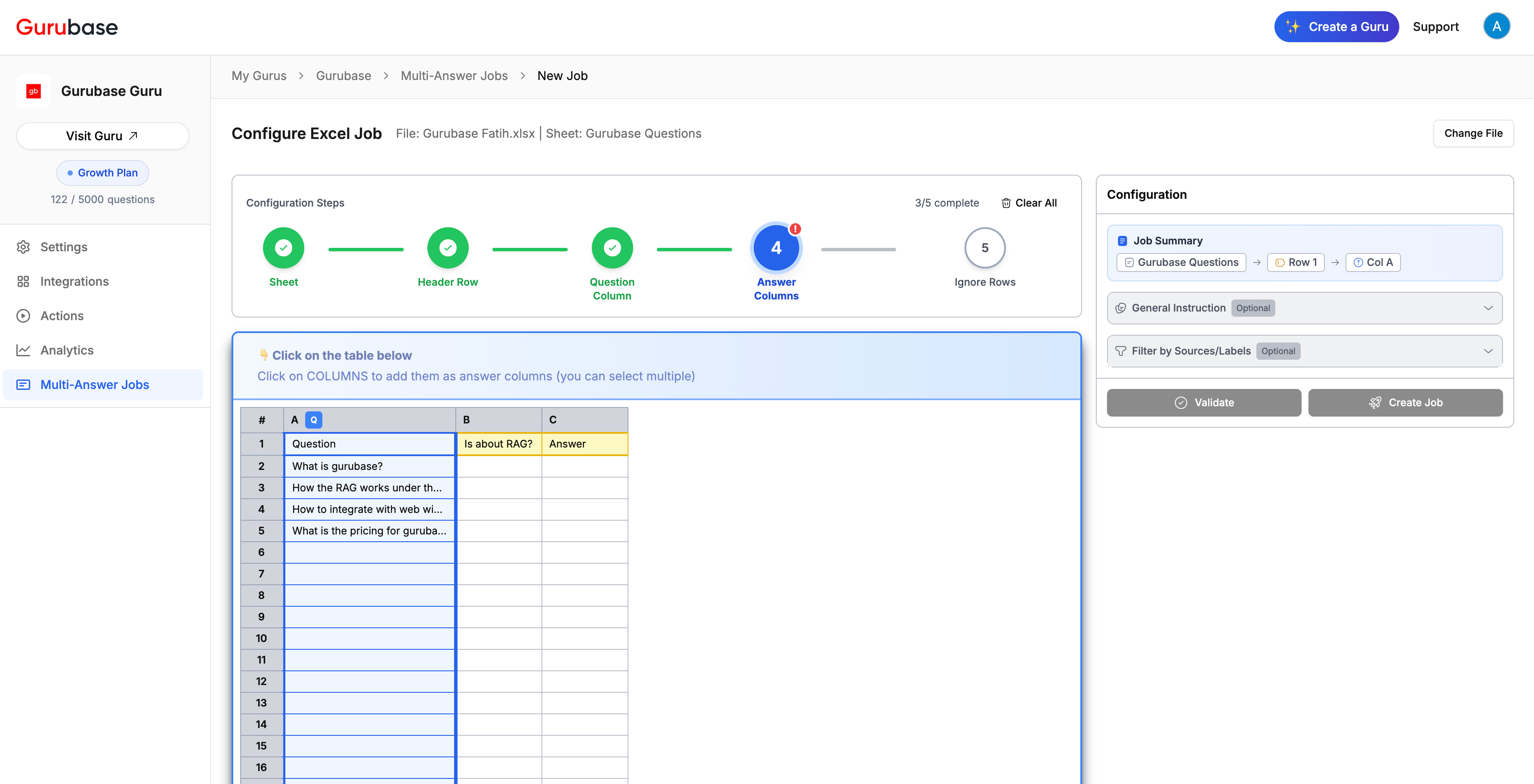
Only the answer cells of the sheets you processed are written. Every other sheet, cell, formula, and format in the original workbook is preserved untouched in the output file.
Ignore Rows (Optional)
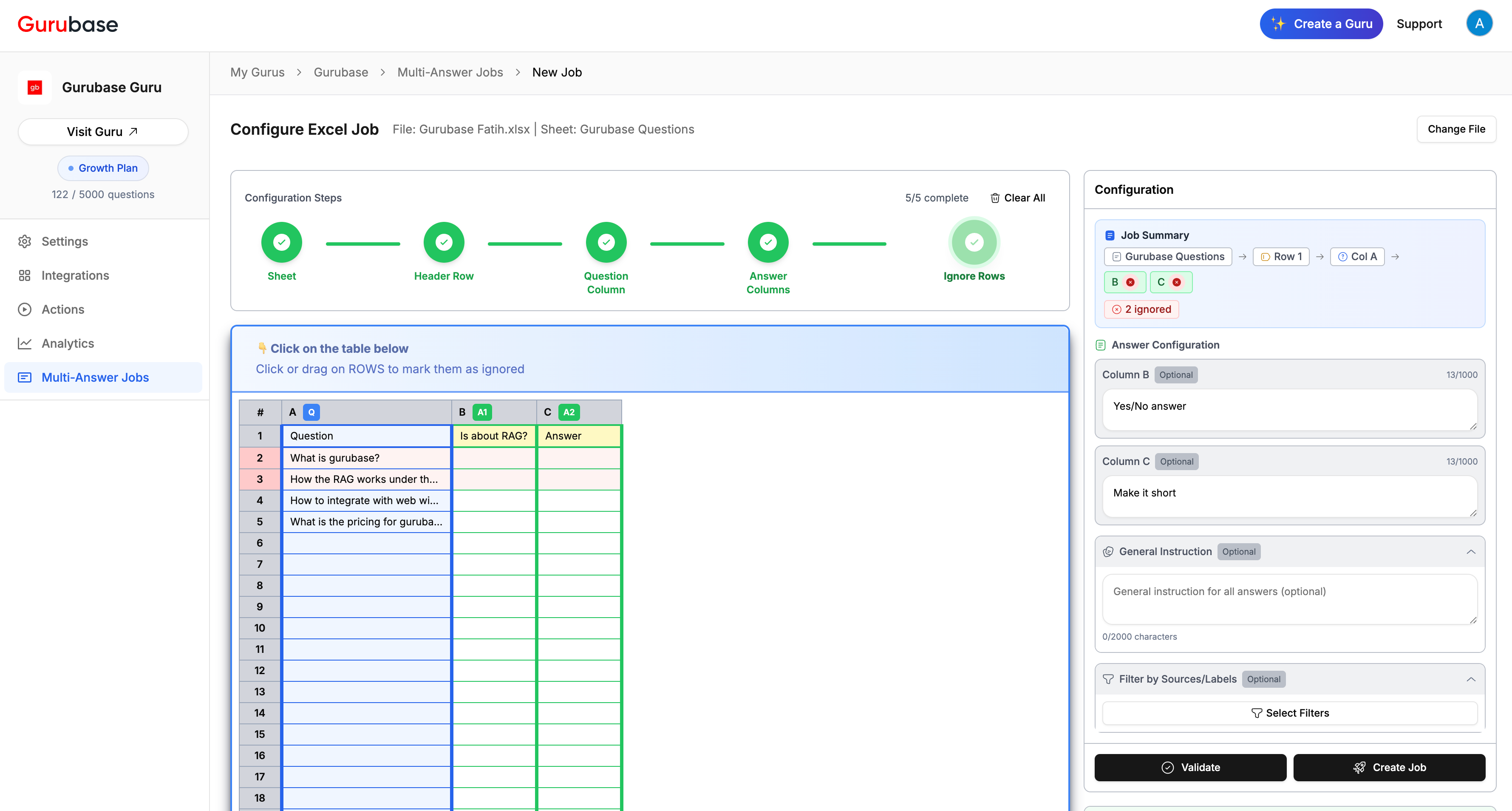
Mark specific rows to be skipped for this sheet — useful for test questions, examples, or invalid entries. Click or drag on ROWS to mark them as ignored.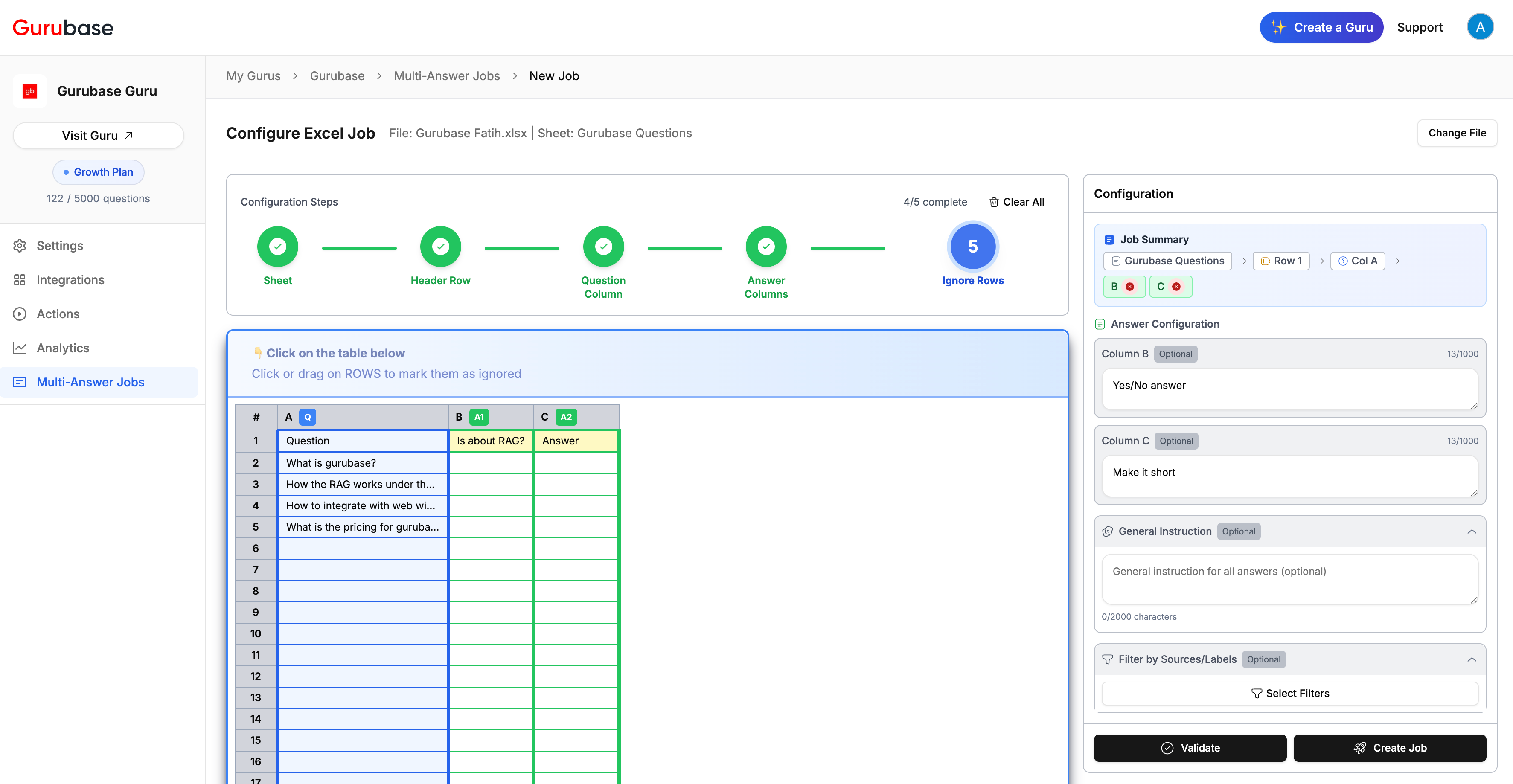
Step 4: Job-wide settings
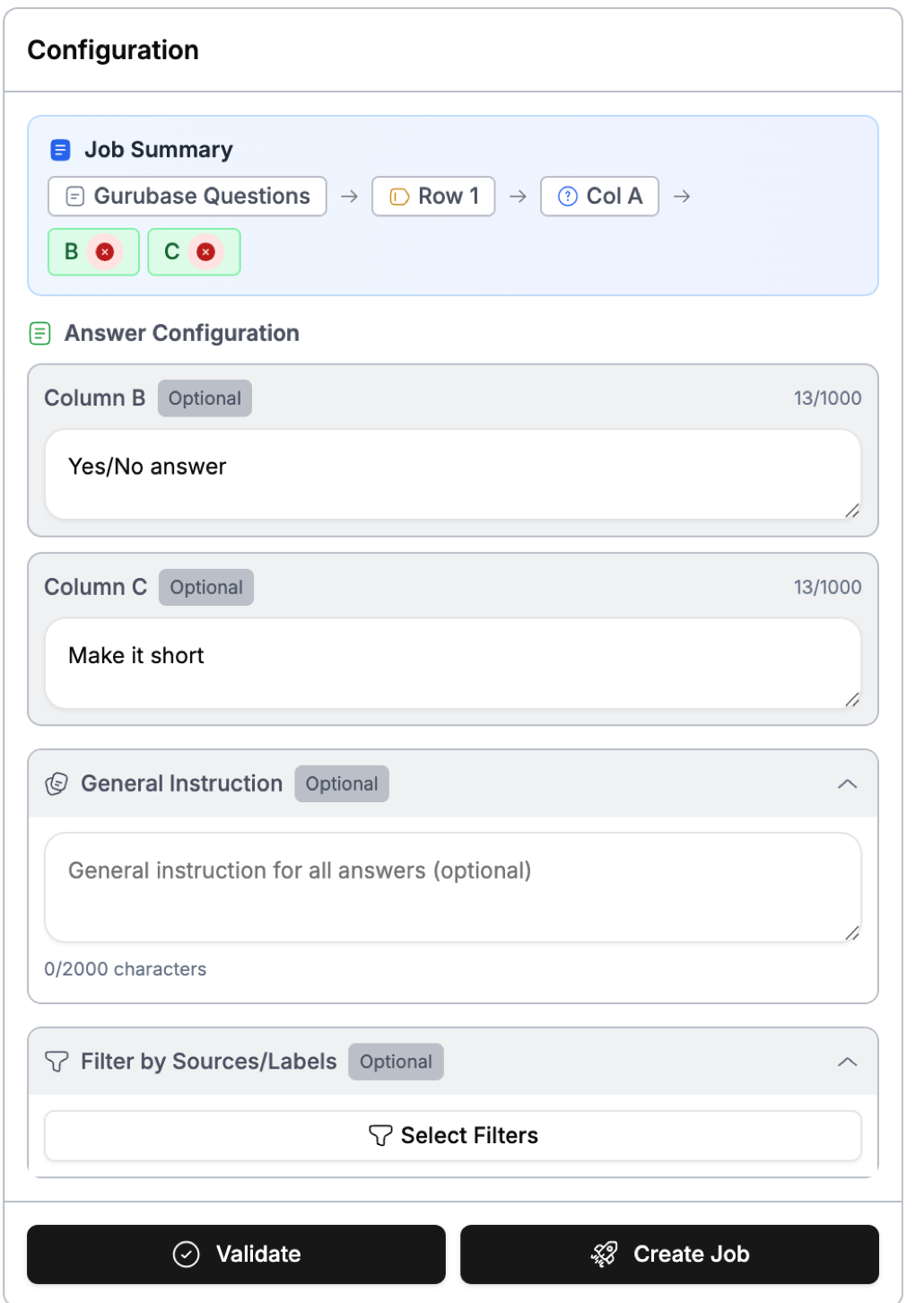
General Instruction (Optional)
Guidance that applies to all answers across all sheets and columns — for consistent tone, style, or context.Column-Specific Instructions (Optional)
In addition to the general instruction, each answer column can carry its own instruction (for example, “Yes/No only” on one column and “detailed answer with policy references” on another).Answer Tools (Optional)
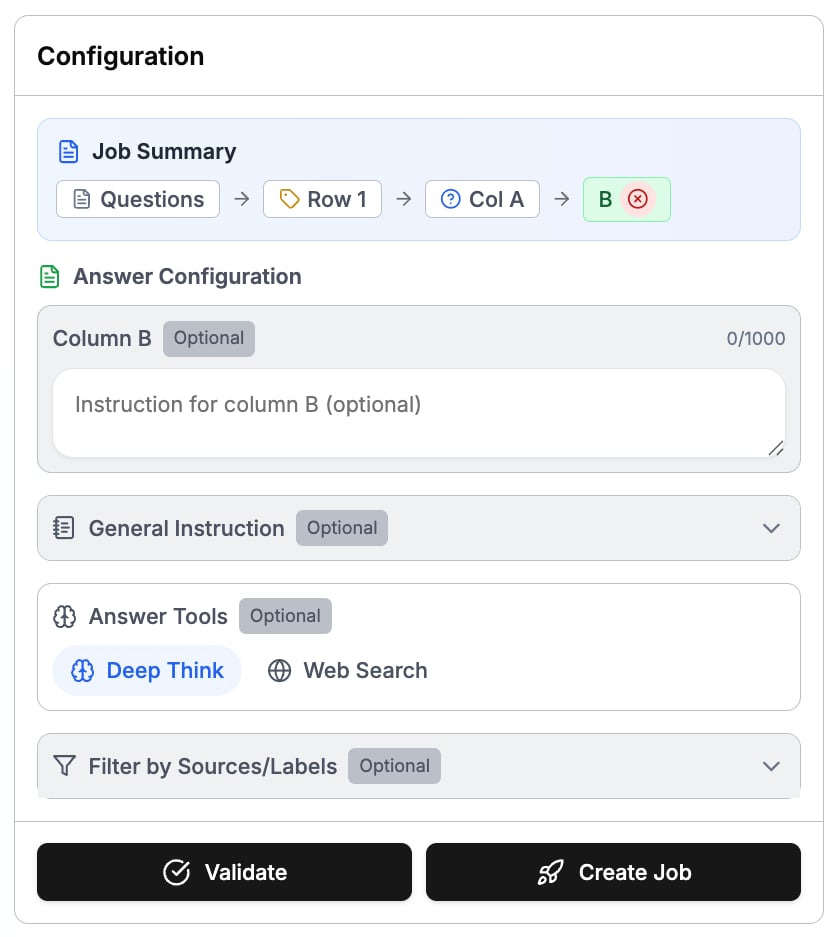
- Deep Think: The model spends more reasoning effort on every answer. Slower, but produces higher-quality responses — useful for complex RFP or compliance questions.
- Web Search: Answers can be supplemented with up-to-date web results when the knowledge base alone is not enough. Web sources are listed in each answer’s references. Shown only when web search is enabled and available for your Guru.
Filter by Sources/Labels (Optional)
Limit which data sources or labels are used when generating answers. The filter applies to every selected sheet.Validation
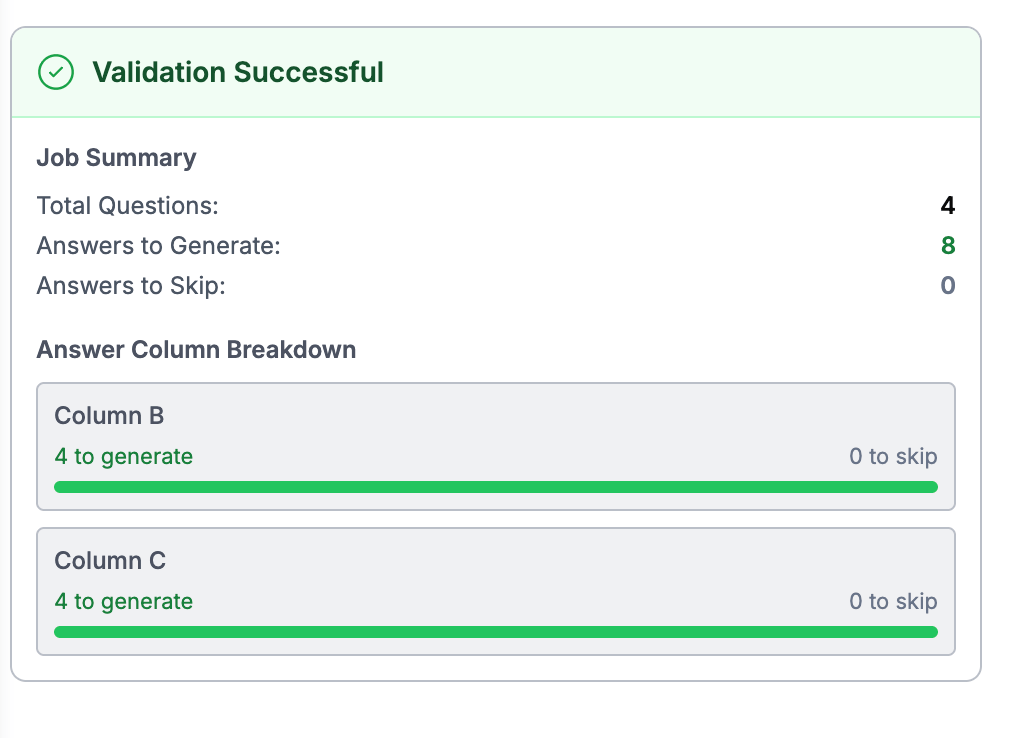
- Total Questions: Questions that will be processed (excluding ignored rows)
- Answers to Generate: Total answers (questions × answer columns)
- Answers to Skip: Answer cells already filled are left untouched and skipped
- Answer Column Breakdown: How many answers will be generated per column
The downloaded result is your original workbook, unchanged except for the answer cells of the sheets you processed. Every other sheet — including hidden and unprocessed ones — comes back exactly as uploaded.
Managing Ongoing Jobs
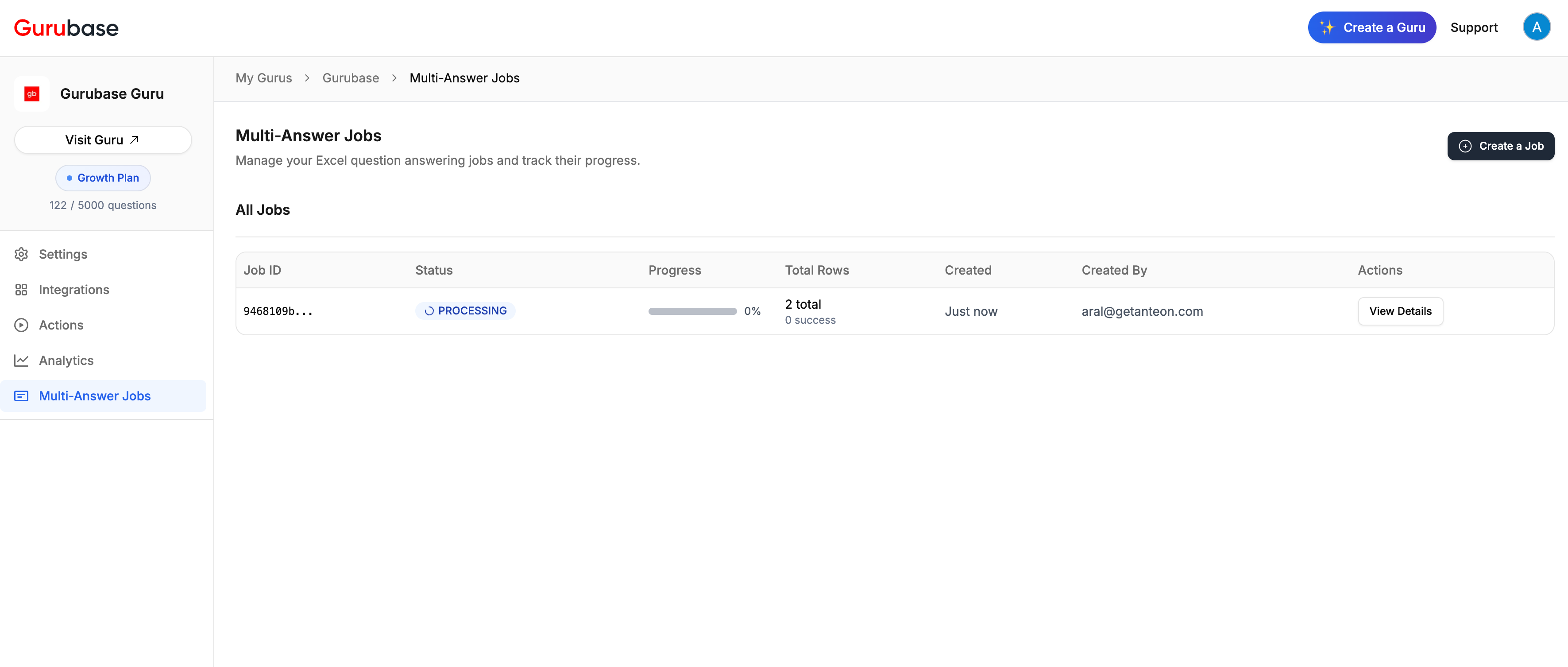
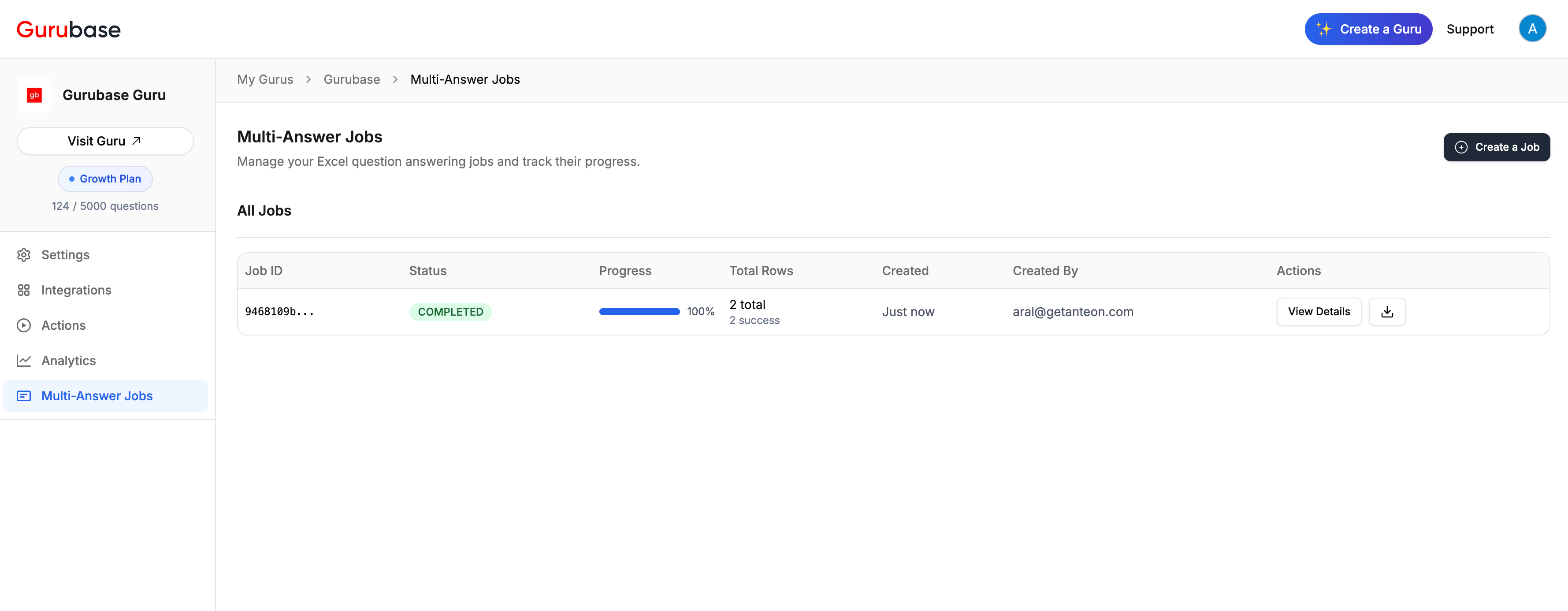
Jobs that are currently processing appear in the jobs table.List
Details
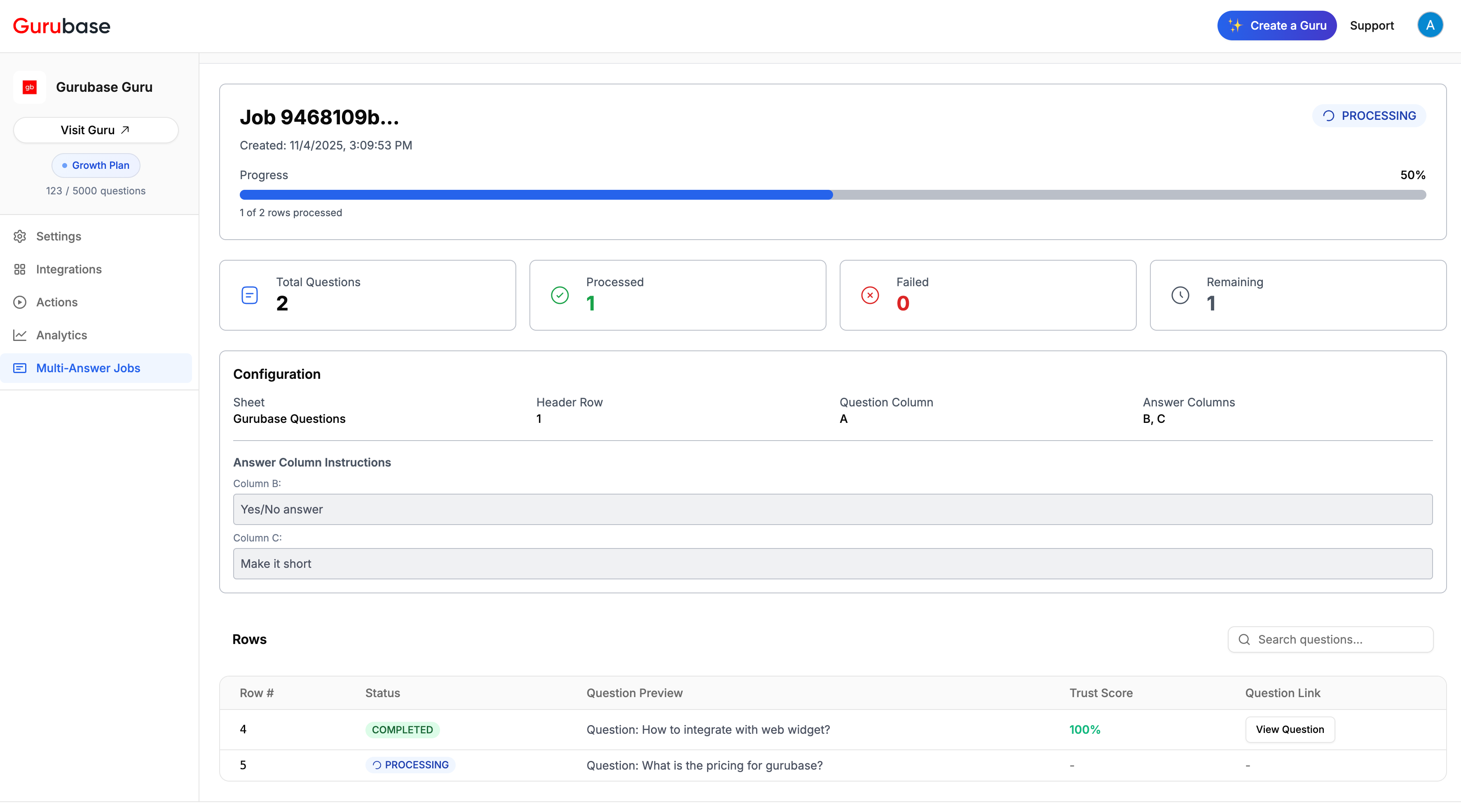
- Progress Bar: Visual indicator showing completion percentage
- Summary Cards: Total questions, processed count, failed count, and remaining count
- Configuration: A per-sheet table of each processed sheet’s header row, question column, and answer columns, plus the job-wide instructions
- Rows Table: Status, question preview, trust score, and links to view full details
Managing Finished Jobs
Completed jobs show “COMPLETED” status and allow you to review results and download them.List
Details
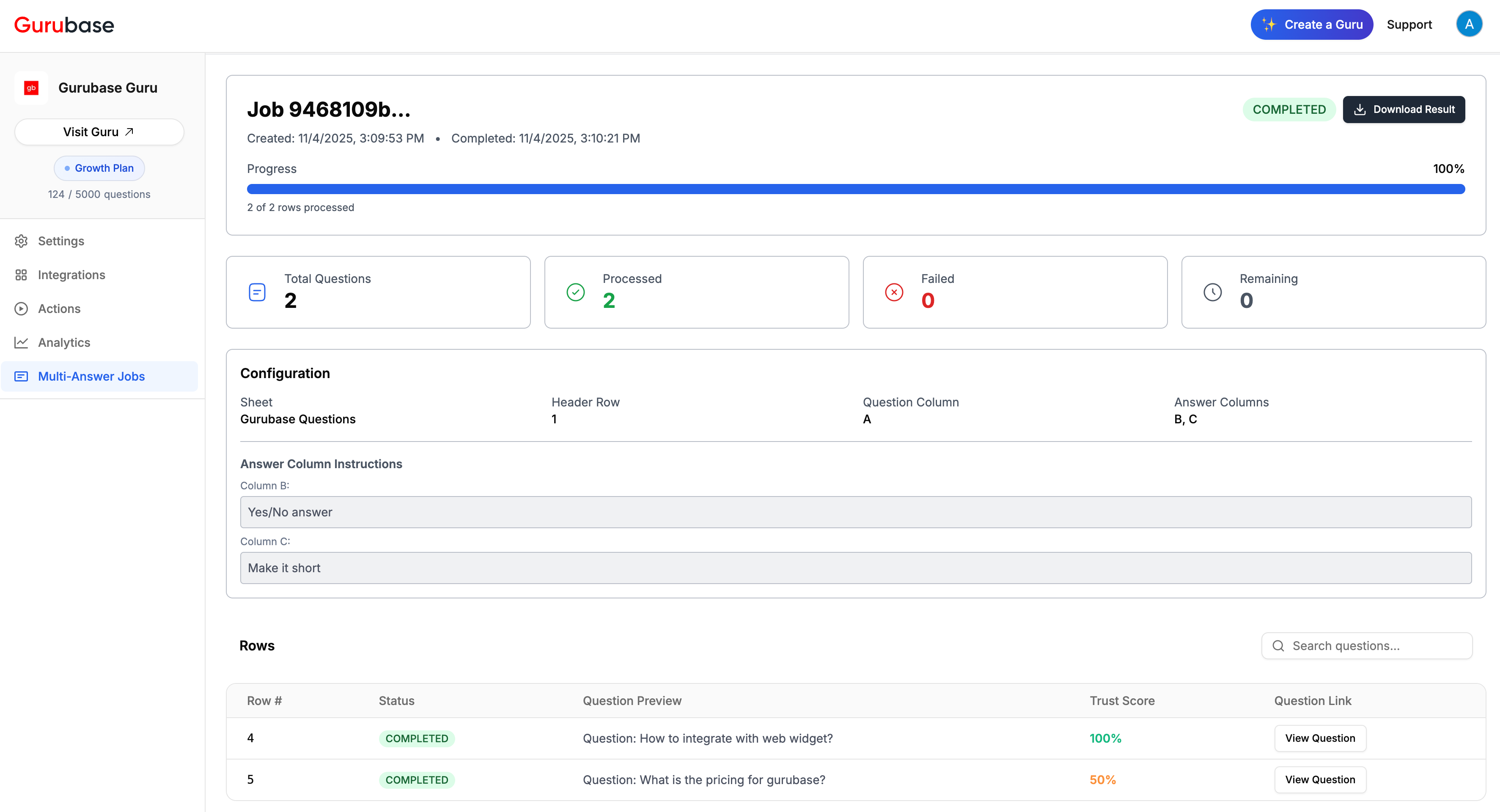
- Download Result: Export the Excel file with generated answers
- Summary Cards: Total questions, processed count, failed count (if any)
- Results Table: Complete list of processed questions with status, trust scores, and links to view full answers
Tips for Best Results
Prepare Your Knowledge Base First
Prepare Your Knowledge Base First
Multi-Answer quality depends on your data sources. Before running large questionnaires:
- Upload relevant policies, documentation, and product specs
- Ensure your SOC 2 report, security policies, and compliance docs are indexed
- Test a few sample questions first to verify coverage
Use Column-Specific Instructions
Use Column-Specific Instructions
Column headers in your Excel file are passed to the model, so a header like “Short Answer” already guides the response. For finer control, each answer column can also have its own instructions:
- Column B: “Answer in 1-2 sentences, formal tone”
- Column C: “Provide detailed answer with specific policy references”
- Column D: “Yes/No only, with brief justification”
Review Trust Scores
Review Trust Scores
Each answer includes a trust score. Prioritize manual review for:
- Low trust scores (answer may need more context)
- Questions outside your knowledge base coverage
- Answers that reference general knowledge vs. your specific docs
Filter by Labels for Targeted Answers
Filter by Labels for Targeted Answers
Your data sources can have labels (e.g., “security”, “product”, “legal”). When creating a Multi-Answer job, you can filter to only use sources with specific labels.Example: You have 500 documents, but for a security questionnaire, you filter to only “security” labeled sources. The AI will only reference your SOC 2 report and security policies — not product marketing docs.This ensures answers are grounded in the right documents.
Next Steps
Data Sources
Add the documents your Multi-Answer jobs will reference
Excel Extraction
Best practices for preparing Excel files
Prompting Your Guru
Customize how your Guru generates answers
Analytics
Track answer quality and usage patterns