

Overview
Agents are AI-powered orchestrators that can intelligently decide which tools and actions to use based on user questions. Unlike actions that execute a single task, agents can chain multiple tool calls together, make decisions, and handle complex workflows autonomously.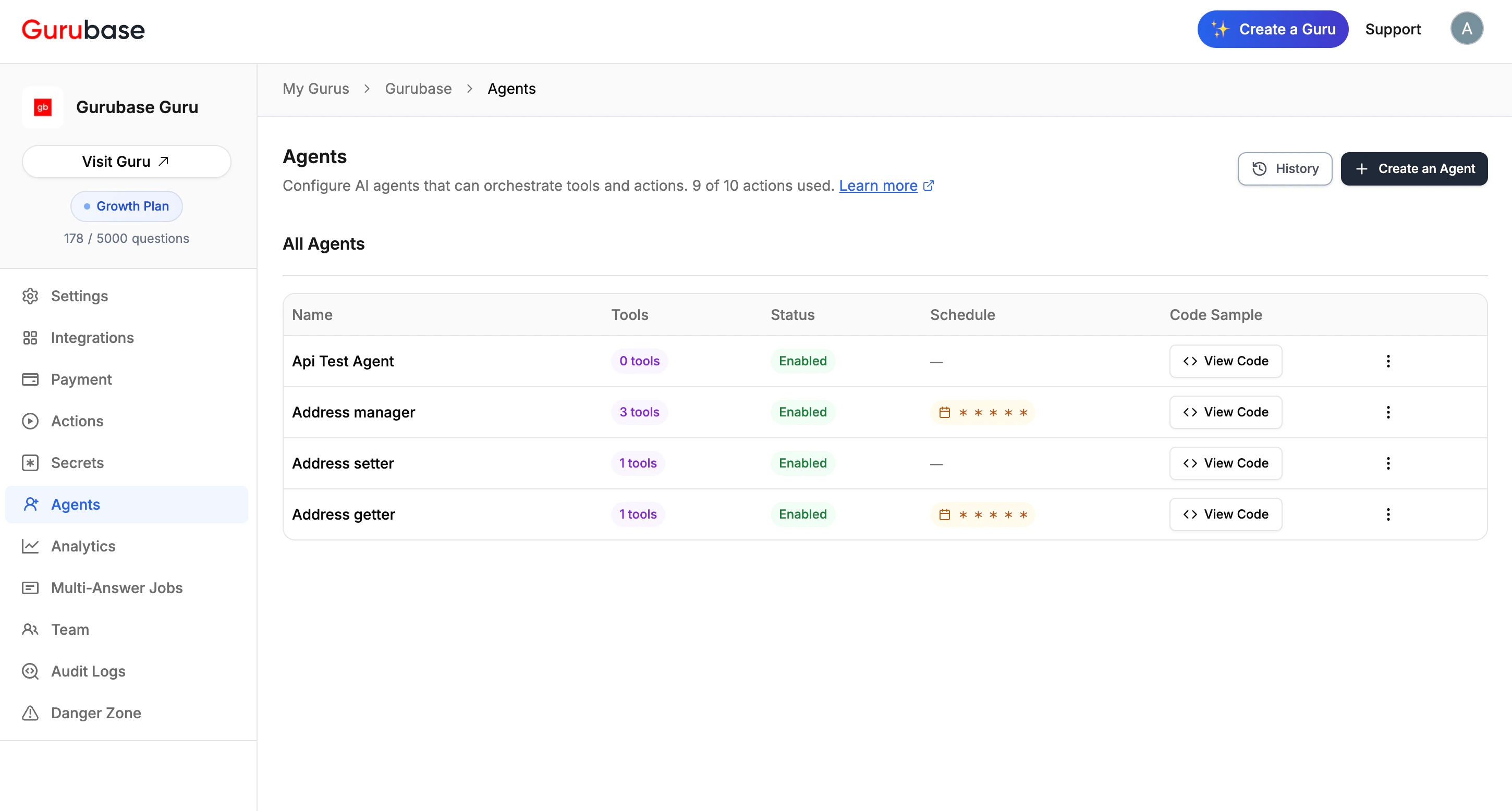
- orchestrate multiple tools and actions
- make autonomous decisions about which tools to use
- chain tool calls together for complex workflows
- handle nested agent calls (agents calling other agents)
- process structured or free-form responses
How Agents Work
Agents use an intelligent orchestration system:- When to Trigger This Agent: The Guru checks if the user’s question matches your defined conditions
- Tool Selection: The agent selects from its available tools (actions or other agents) based on the task
- Execution: The agent makes autonomous decisions about which tools to call and in what order
- Nested Execution: Agents can call other agents, creating nested execution chains
- Response Handling: The Usage Instructions guide the AI on how to interpret and present the agent’s response
Creating an Agent
The agent creation process consists of four main steps:- Basic Information
- Tool Selection
- Agent Configuration
- Usage Instructions, Scheduling, and Testing
Basic Information
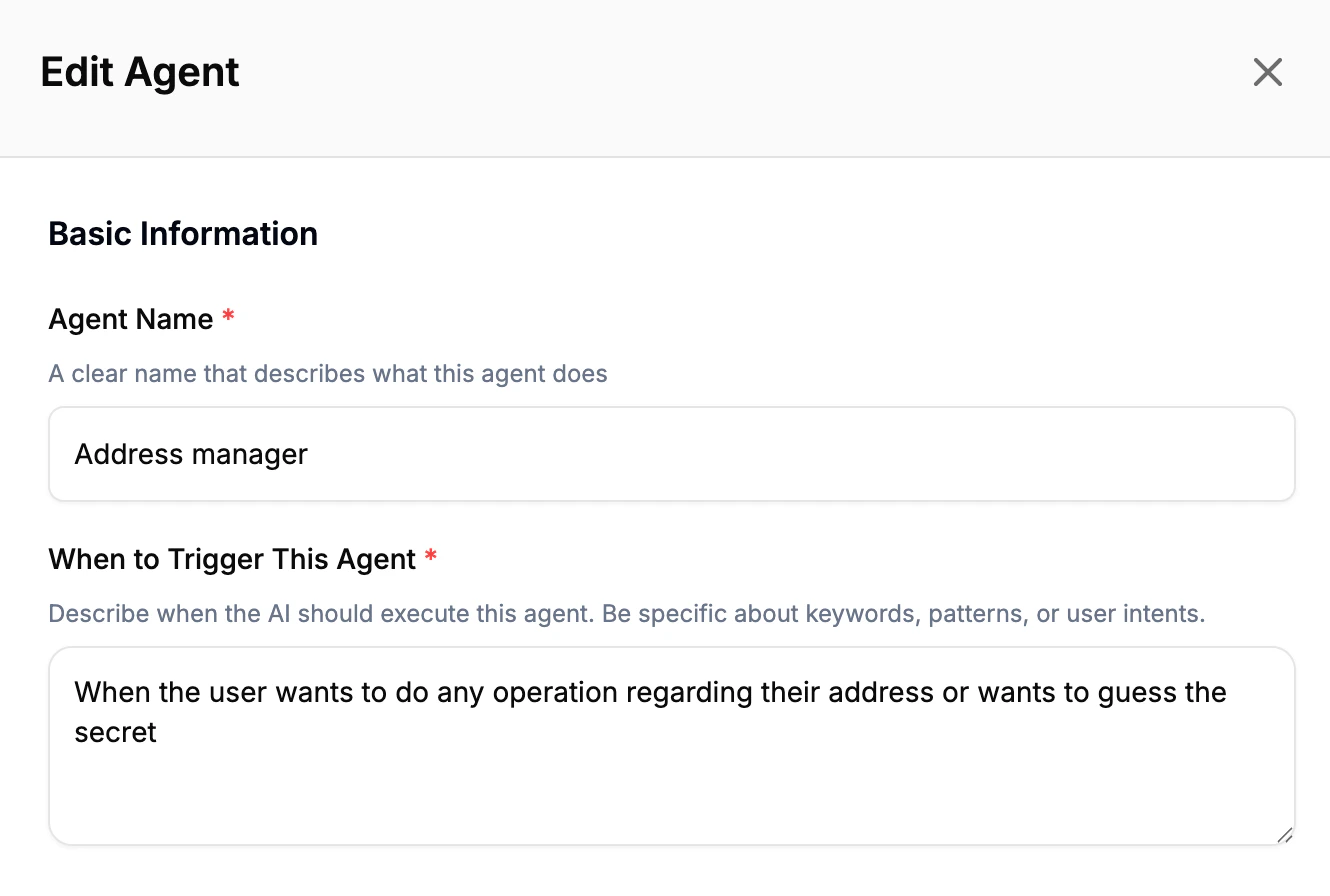
- Agent Name: Provide a descriptive name that appears in your agents list (e.g., “Address manager”)
- When to Trigger This Agent: Be specific about keywords, patterns, or user intents to ensure it only runs when appropriate
- Example: “When the user wants to do any operation regarding their address or wants to guess the secret”
Agent Configuration
-
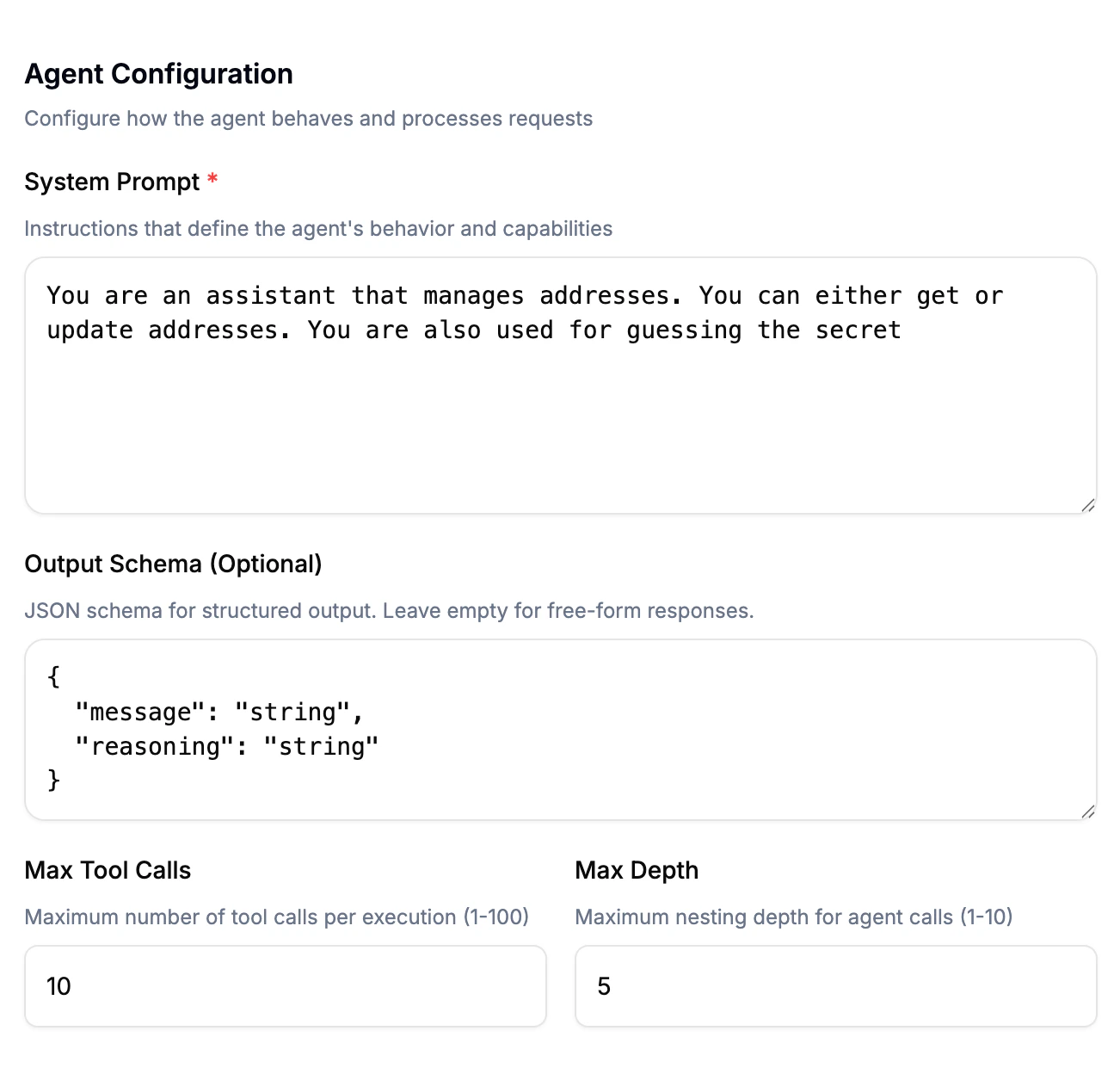
System Prompt: Required instructions that define the agent’s behavior and capabilities
- Example: “You are an assistant that manages addresses. You can either get or update addresses. You are also used for guessing the secret”
-
Output Schema (Optional): JSON schema for structured output. Leave empty for free-form responses
- Example:
-
Max Tool Calls: Maximum number of tool calls per execution (1-100)
- Limits how many tools the agent can call in a single execution
- Default: 10
-
Max Depth: Maximum nesting depth for agent calls (1-10)
- Controls how deeply agents can call other agents
- Default: 5
- Prevents infinite recursion in nested agent scenarios
Tool Selection
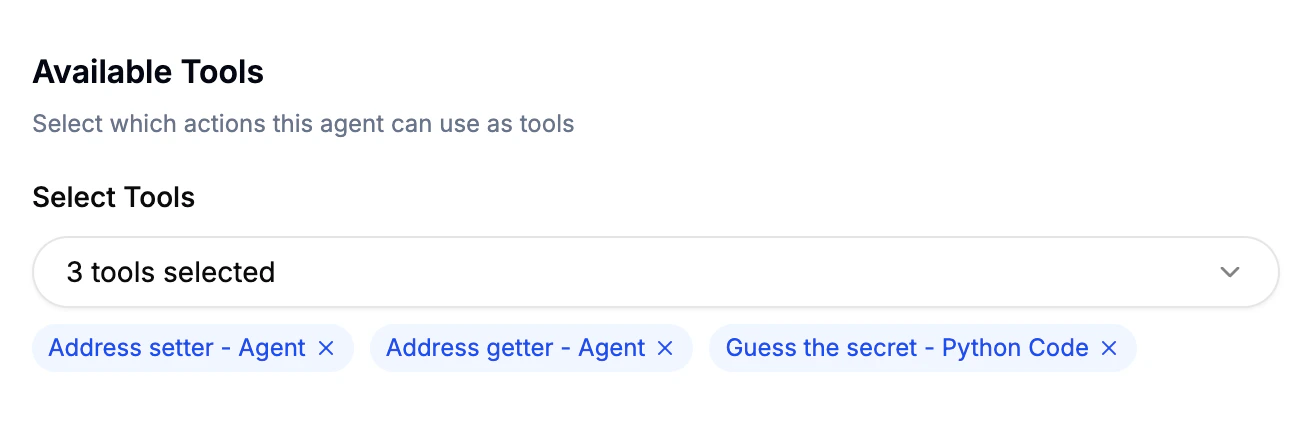
- Actions: Python Code and API Call actions you’ve created
- Other Agents: Other agents in your Guru (enabling nested agent calls)
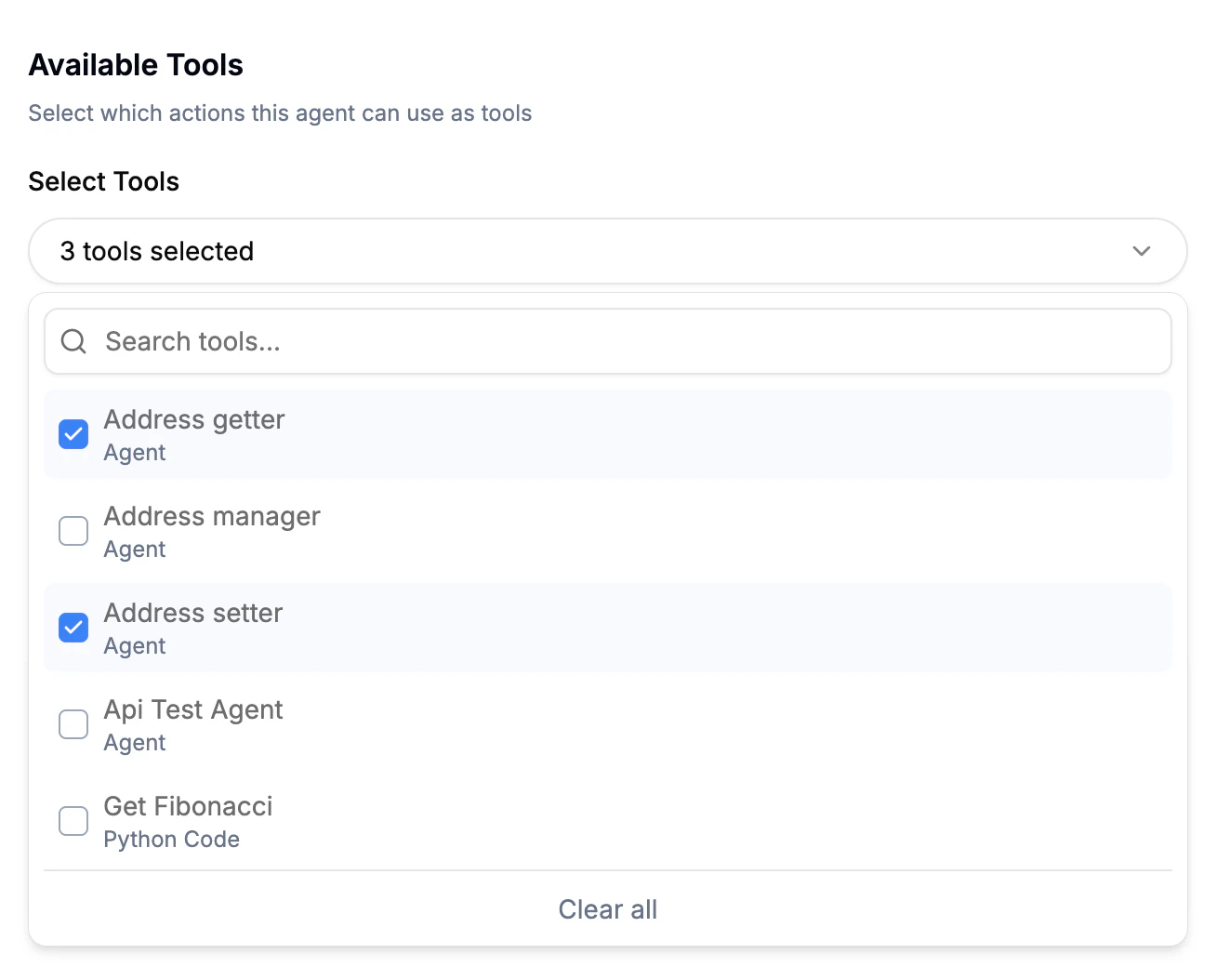
- Use the search bar to filter available tools
- Selected tools appear as tags that can be removed individually
- Use “Clear all” to deselect all tools
- The agent will intelligently choose which tools to use based on the user’s question
Usage Instructions and Testing
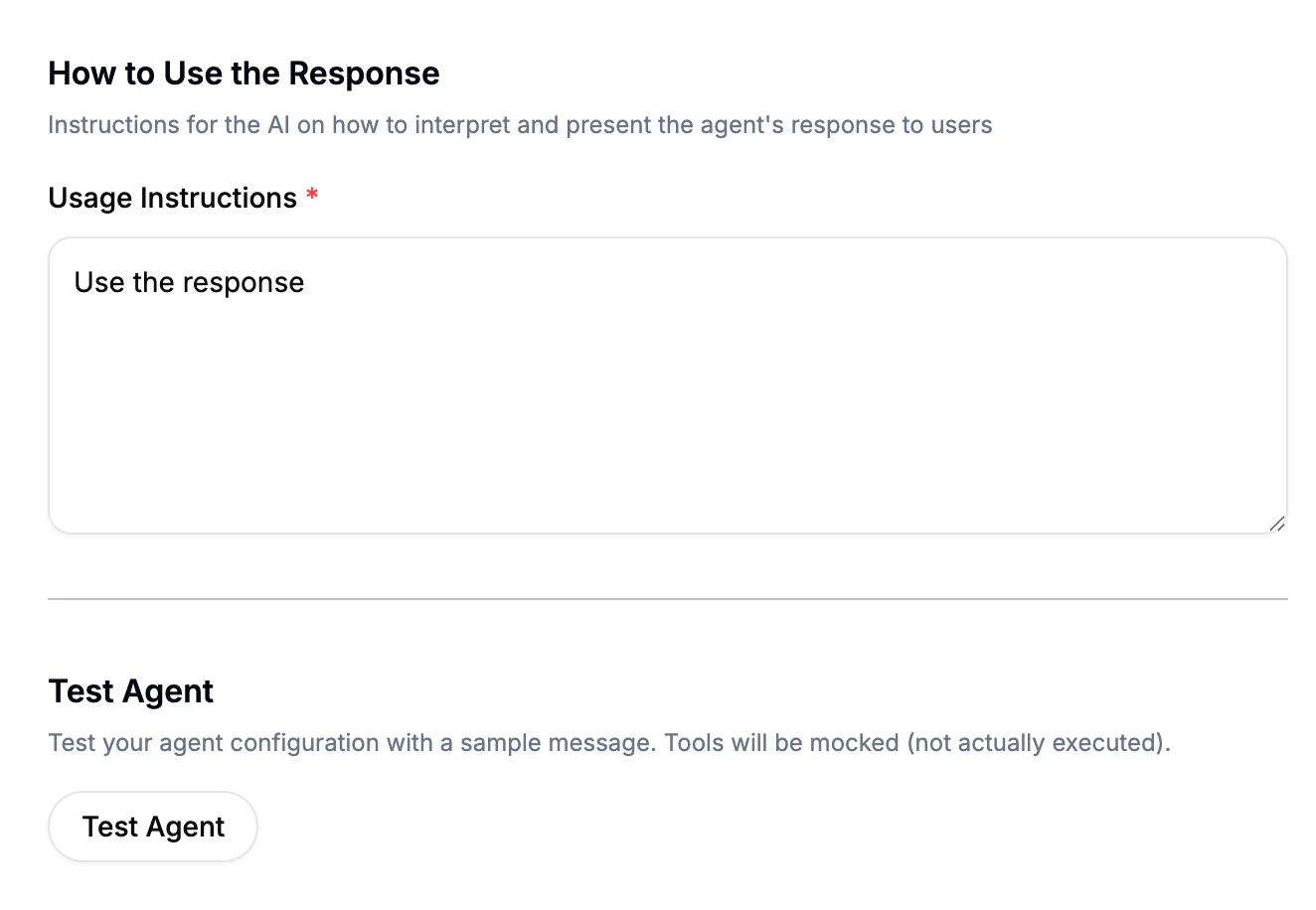
- Usage Instructions: Provide instructions for how the AI should interpret and present the agent’s response to users
- Example: “Extract the message and reasoning from the JSON response and present them in a clear format”
- Use the “Test Agent” button to verify your configuration
- Tools will be mocked (not actually executed) during testing
- Test results show the agent’s decision-making process and tool selection
Scheduling
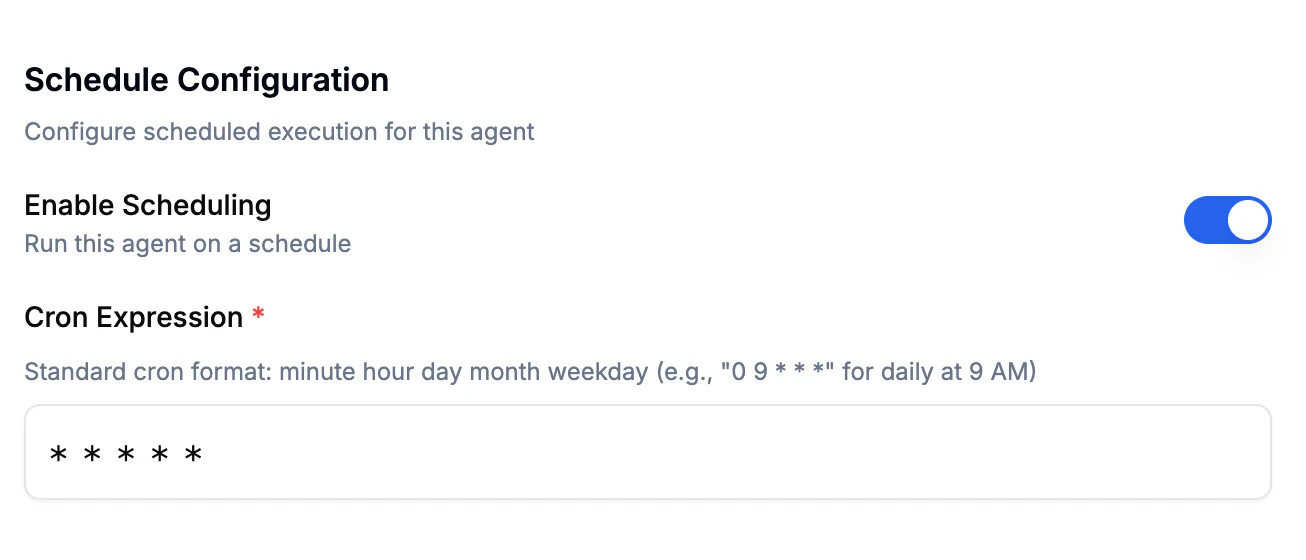
- Enable scheduling using the toggle switch
- Configure the execution schedule using a cron expression in standard format:
minute hour day month weekday- Example:
0 9 * * *runs daily at 9 AM - Example:
*/5 * * * *runs every 5 minutes
- Example:
- Scheduled agents display their cron expression in the agents list
Managing Agents
- View all configured agents with their name, number of tools, status (Enabled/Disabled), and schedule (cron expression if scheduled)
-
Click the menu icon (⋮) next to any agent to:
- Edit: Modify the agent’s configuration
- Disable: Temporarily disable without deleting
- Delete: Permanently remove the agent
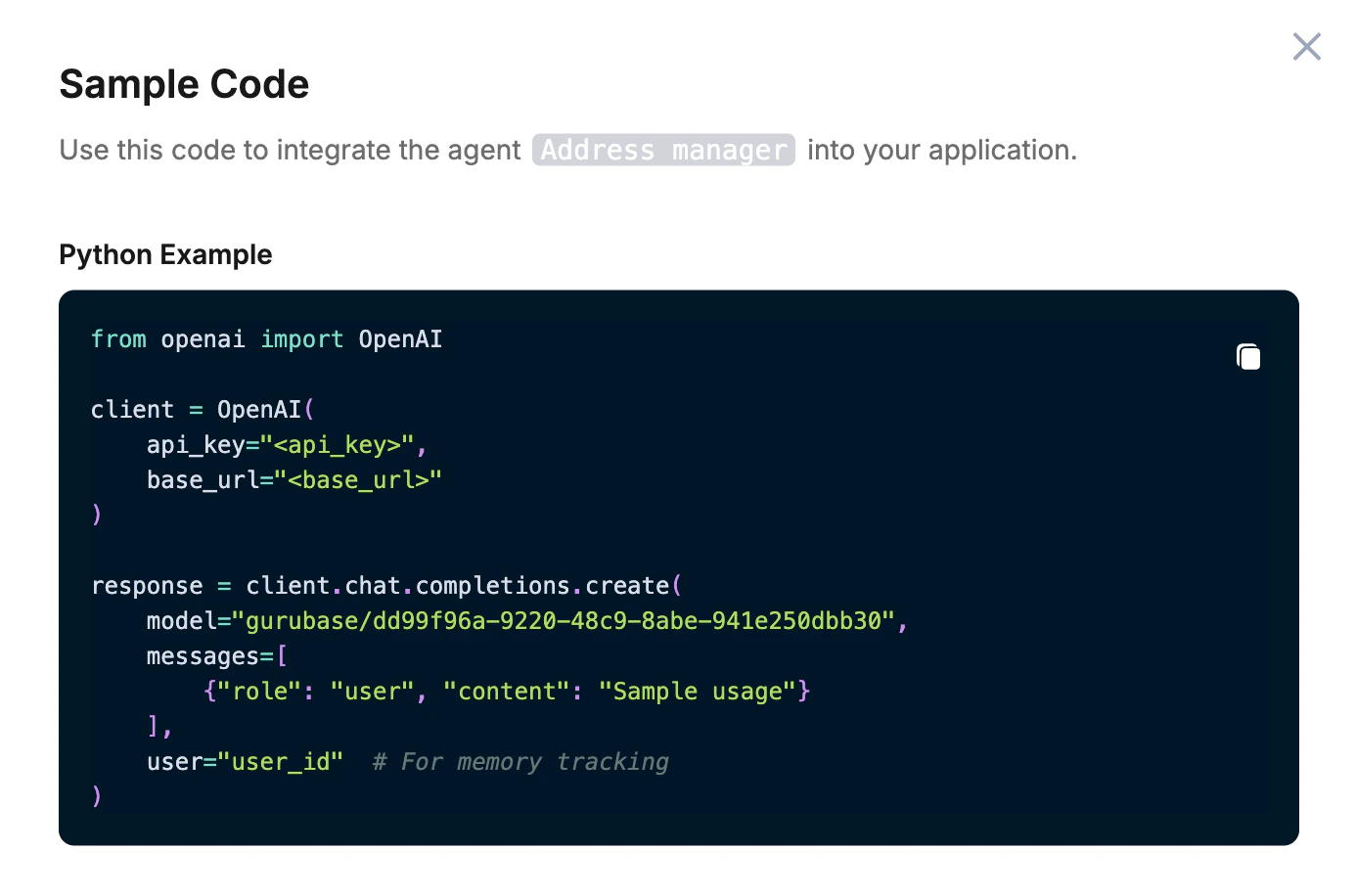
- Click “View Code” to see integration code samples for the agent
- Enable or disable agents at any time
- Disabled agents won’t be triggered by user questions
- Note: If a tool (action or agent) used by an agent is deleted, that agent will be automatically disabled
Agent History
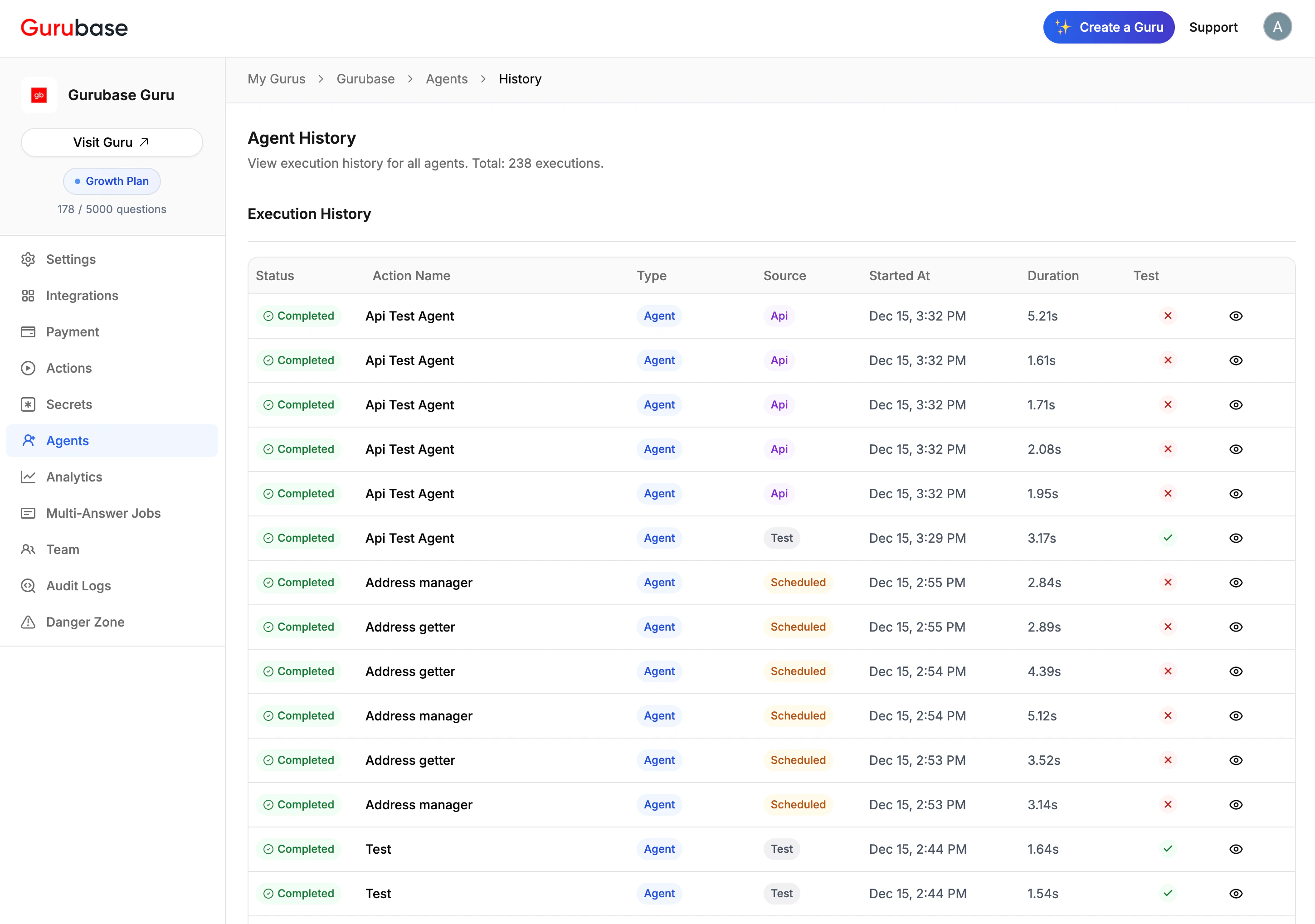
- Status: Execution outcome (Completed or Failed)
- Action Name: Name of the executed agent
- Type: Always “Agent” for agent executions
- Source: How the agent was triggered (Api, Scheduled, Test, etc.)
- Started At: Date and time when execution began
- Duration: Execution time in seconds
- Test: Whether the execution was a test run
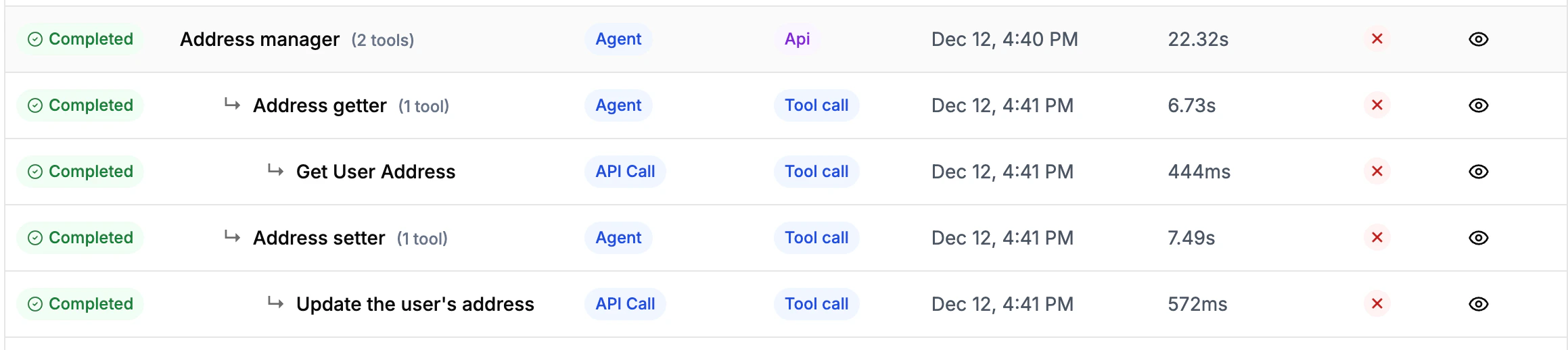
- Top-level agent execution
- Indented tool calls showing which tools were called
- Further indentation for nested agent calls
- Each level shows its own status, duration, and type
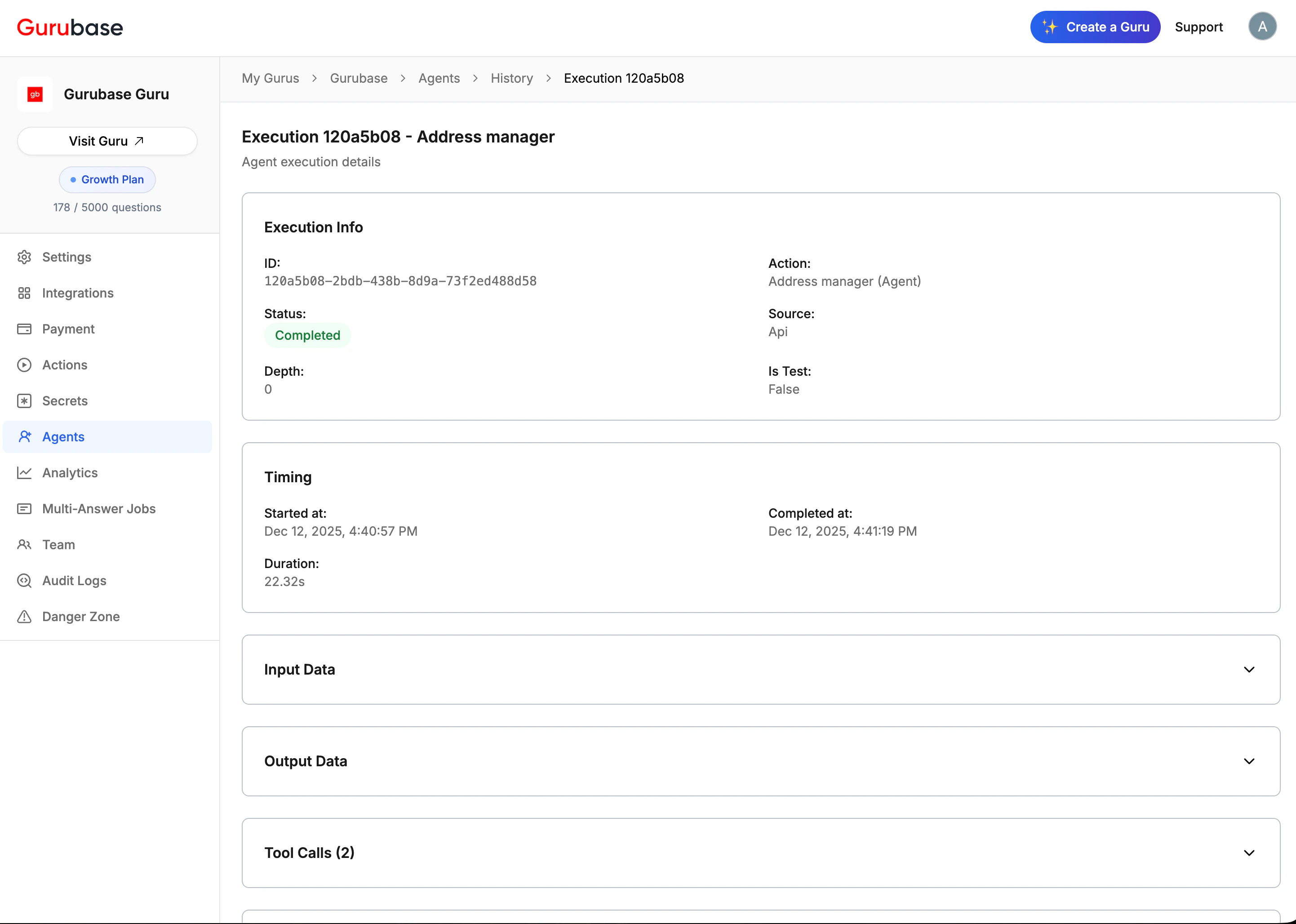
- Execution Info: Unique execution ID, status, depth, agent name, source, and test flag
- Timing: Start time, duration, and completion time
- Input Data: Parameters and values used during execution (collapsible)
- Output Data: Agent’s response data (collapsible)
- Tool Calls: List of all tool calls made during execution (collapsible)
- Nested Executions: Immediate childrens of the agent (collapsible)
Integration
Common Mistakes to Avoid
Vague Trigger Conditions: ❌ “When asking about data” → ✅ “When the user wants to do any operation regarding their address” Inadequate System Prompts: ❌ “You are a helpful assistant” → ✅ “You are an assistant that manages addresses. You can either get or update addresses. You are also used for guessing the secret” Too Many Tools: ❌ Selecting 20+ tools for a single agent → ✅ Select only the tools relevant to the agent’s specific purpose Incomplete Usage Instructions: ❌ “Use the response” → ✅ “Extract the message and reasoning from the JSON response and present them in a clear, formatted summary” Not Testing Agents: ❌ Enabling agents without testing them first → ✅ Always test agents with various scenarios before enabling Excessive Nesting Depth: ❌ Setting max depth to 10 without considering complexity → ✅ Start with lower depth (3-5) and increase only if needed Missing Output Schema: ❌ Not defining output schema when structured data is needed → ✅ Define a clear JSON schema for consistent, parseable responsesNext Steps
Actions Guide
Learn how to create actions that agents can use as tools
API Reference
Explore our API documentation for advanced integrations
Create Your First Guru
Learn how to create and configure your first Guru
Prompting Your Guru
Learn how to customize your Guru’s responses and behavior